Piano Keyboard Layout
A piano keyboard is the set of adjacent depressible levers on a piano which causes the piano to produce sounds. Many other instruments share this layout. These instruments include the harpsichord, clavichord, organ, electric piano, digital piano, synthesizer, electronic keyboard, celesta, melodica, glasschord, dulcitone, accordion, and carillon. Of all the instruments mentioned above, the piano is of course the most encountered. So people usually refer to the keyboard layout as the piano keyboard.
Highly Recommended: Go here for the BEST piano/keyboard course I’ve seen on the Internet.
The keyboard makes use of the twelve notes of the western musical scale. The larger/longer keys are often colored white and jut forward. These are the seven natural notes of the C major scale: C, D, E, F, G, A, B. They are often referred to as white notes or white keys. The remaining 5 black notes or black keys are smaller/shorter and not part of the C major scale. These are namely, C-sharp/D-flat, D-sharp/E-flat, F-sharp/G-flat, G-sharp/A-flat, and A-sharp/B-flat. This pattern of notes repeats at octaves (i.e.every 8 tones).
Piano keyboard layout
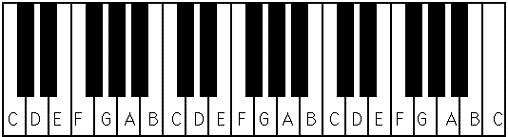
As can be seen above, on the piano keyboard the black notes are grouped together in groups of two and three. The note C is situated just before (or to the left of) the grouping of two. Starting with the note C, the other notes, in order, would be C, C-sharp, D, D-sharp, E, F, F-sharp, G, G-sharp, A, A sharp, B, and then C (one octave higher).
When learning how to play keyboard or piano, you often hear the term Middle C. What is middle C? Well on a piano there are 8 "C notes"; the one in the middle of the piano is known as middle c. Just sit on the bench correctly positioned in front of a piano and look down. Chances are you will be looking directly at middle C.
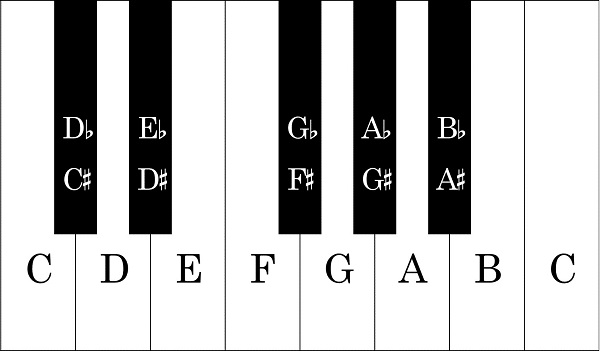 Piano Keyboard Layout
On a piano keyboard, you find what is called "semitones" and "tones". The interval between C and D, D and E, F, and G, etc. are all known as tones. However, the interval between C and C-sharp, D and D-sharp, E and F, etc. are known as semitones. Between B and C, and E and F, there are no black notes and therefore the interval between them are also semitones. To further clarify my point, C-sharp is one semitone higher than C, C is one semitone lower than C-sharp, D is one tone higher than C, and so on.As you may have noticed above, all the black keys on a piano have two different names. So C-sharp is also known as D-flat, D-sharp is also known as E-flat, F-sharp is also known as G-flat, G-sharp is also known as A-flat, and A-sharp is also known as B-flat.
A historical look
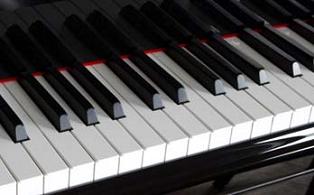
On today's piano keyboard, the white notes are longer and larger, while the black notes (sharps and flats) are shorter and smaller. But on many keyboard instruments dating from before the nineteenth century, the colors of the keys were reversed. Darker colored keys were used for the white notes while black keys were used for the white ones. Electric and electronic instruments with this feature included Vox's electronic organs of the 1960s, Roland's digital harpsichords, Hohner's Clavinet L, and one version of Korg's Poly-800 synthesizer.
Acoustic pianos come with 88 weighted keys. Keys are heavier in the lower registers of the piano keyboard and lighter in the higher registers. A piano will produce a louder note the faster and harder the key is depressed.
Today
Today's digital pianos are patterned after acoustic pianos and try to replicate their touch and feel.
In addition to acoustic pianos, there are many brands of musical keyboards such as Yamaha, Roland, and Korg. They manufacture many models that usually come with 61, 76, or 88 keys. We review several of these keyboards and digital pianos here, particularly the Yamaha brand, as the name of this website (Yamaha-Keyboard-Guide.com) suggests.
More and more players are buying digital pianos instead of more expensive acoustic pianos. They have several advantages over acoustic pianos. They do not have to be tuned, they are portable, they are cheaper, they can be used with headphones (to avoid disturbance), they are computer compatible, and they have a wide variety of sounds (unlike pianos which only have one).
Return from Piano Keyboard Layout to Yamaha Keyboard Reviews.



Search This Site:

Recommended For You
Learn to play piano and keyboards:

Click here to learn how to play keyboards and piano (with Piano For All).
Go here to buy a Yamaha keyboard.
Check out How To Read Music Fast: A 4-Step Beginner's Guide To Reading Music Quickly And Easily.
New! Comments
Have your say about what you just read! Leave me a comment in the box below.